
Uncovering a Maidstone Female Artist: Margaret (Peggy) Hazlitt
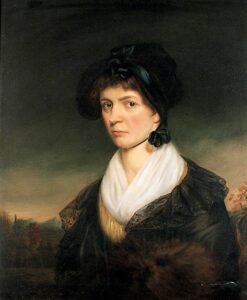
(Portrait in the collection of Margaret by her brother John, (MNEMG 1909.67.27/PCF 413)
A blog by Samantha Harris, Collections Manager
Female artists are often hidden and underrepresented in Museum Collection. In this blog we will highlight an overlooked, local female artist from a famous Maidstone family!
Margaret “Peggy” Hazlitt’s life offers a quiet but revealing window into the world of late-18th and early-19th-century women—especially those whose talents were real but whose opportunities were limited by duty, circumstance, and gender expectations. Her story sits at the heart of one of England’s most intellectually vibrant families, yet she remains its most overlooked member.
Margaret Hazlitt: A Biography of a hidden female artist
Early Life and Family
Margaret Hazlitt was born on 11 December 1770 in Maidstone, Kent, the middle child of the Reverend William Hazlitt and Grace Loftus Hazlitt. She grew up alongside two gifted brothers: the essayist and critic William Hazlitt and the portrait painter John Hazlitt. Within this close-knit trio, Peggy was remembered as the emotional centre of the family—gentle, affectionate, and deeply loyal. She later wrote that the bond between her brothers was unshakeable: “While they lived, their bond of brotherly love was never broken.”
A Transatlantic Childhood
In 1783, at the age of thirteen, Peggy travelled with her family to America, an experience she later recorded in a journal that remained unpublished until 1967 as ‘The Journal of Margaret Hazlitt: Recollections of England, Ireland, and America’. Her writing captures the texture of everyday life, the family’s movements between countries, and her perceptive observations of the people around her. Though modest in tone, the journal is now valued as a rare female perspective from a family otherwise dominated by male voices.
Artistic Talent and Creative Life
Like her brothers, Peggy possessed a natural artistic ability. A member of her father’s congregation in Wem later recalled that she was “highly gifted, like her brother, and very artistic.” Her interest in painting was evident early: during a visit to London in 1787, she delighted in the print-shop windows and treasured a print her father bought her—The Fishstealers by Moonlight from Boydell’s in Pall Mall.
Her surviving works, held today by Maidstone Museum, include landscapes and rural scenes painted in a Dutch-influenced style. Among them are:
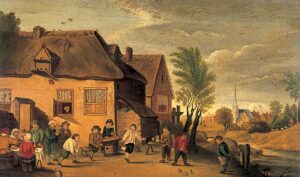
· Peasant Scene (MNEMG 1909.67.31)
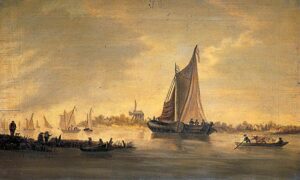
· Canal Scene (MNEMG 1909.67.30)
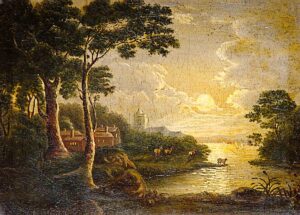
· Moonlight Scene (MNEMG 19097.67.32)
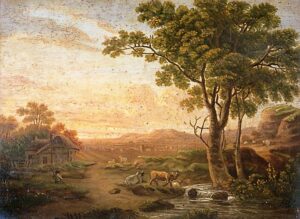
· Landscape with Cattle and Stream (MNEMG 1909.67.33)
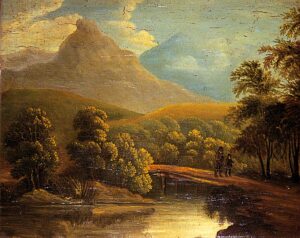
· Mountain Scene with Stream, Bridge and Two Figures (MNEMG 1909.67.35)
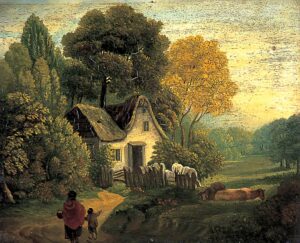
· Cottage in a Wood with Cattle (MNEMG 1909.67.34)
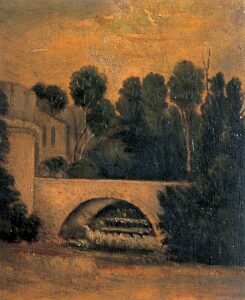
· Bridge and Waterfall (MNEMG 1909.67.35.b)
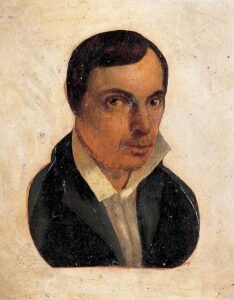
· A portrait of an unknown man, possibly William Hazlitt (MNEMG 1909.35.a)
These works reflect the artistic “accomplishment” expected of educated women of her time—yet they also show genuine skill, sensitivity, and an eye for atmosphere.
A Life of Duty and Devotion
Peggy never married, a choice or circumstance that shaped much of her adult life. She spent many years caring for her ageing parents, a role that limited her independence but also placed her at the heart of the family’s emotional life. Her journal and the recollections of others suggest a woman of kindness, steadiness, and quiet intelligence—someone who observed more than she asserted, and who supported the ambitions of the men around her even when she had little space to pursue her own.
Later Years and Legacy
Margaret Hazlitt died in Liverpool in 1844. The house in Maidstone where she spent her early years, once located in Rose Yard between the High Street and Earl Street, no longer survives. Her legacy, however, endures through her journal and her paintings—rare traces of a woman whose life was shaped by creativity, family devotion, and the constraints placed on women of her era.
During Women’s History Month, Margaret Hazlitt stands as a reminder that history is not only made by the celebrated figures whose names dominate the record. It is also shaped by women whose contributions were quieter but no less meaningful—women who created, cared, observed, and recorded, even when the world offered them little recognition.